Understand Your Obligations
Clarify applicability, roles, information flows and exemptions before defining the compliance work.

Ccpa / cpra compliance
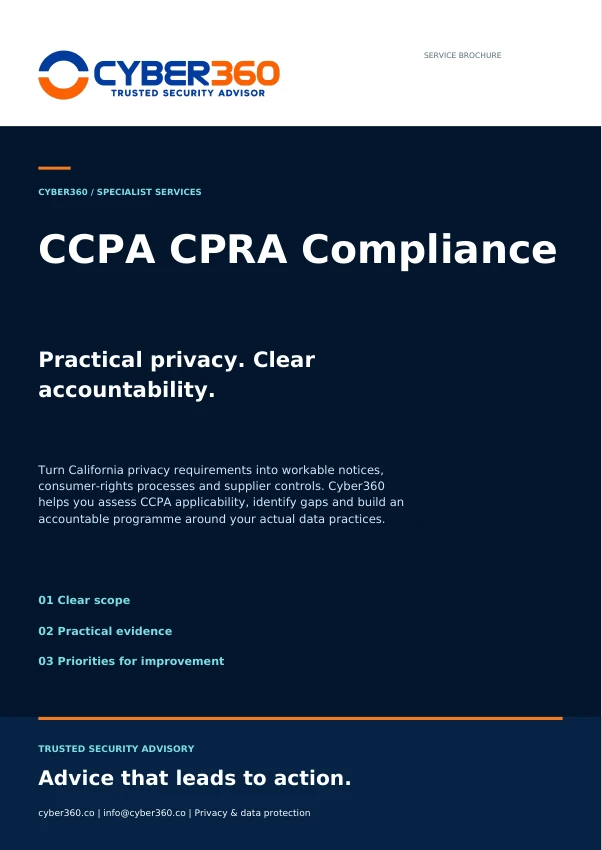
Turn California privacy requirements into workable notices, consumer-rights processes and supplier controls. Cyber360 helps you assess CCPA applicability, identify gaps and build an accountable programme around your actual data practices.
Privacy & data protection • Practical controls. Clear accountability.
From questions to decisions
Your notices, advertising tools, suppliers and request-handling teams need to tell the same story. We help connect what you collect and disclose with the choices you offer and the evidence you retain.
Clarify applicability, roles, information flows and exemptions before defining the compliance work.
Connect consumer-facing privacy controls with the systems and suppliers that must honour them.
Document decisions, responsibilities and improvements so the programme can adapt as practices change.
When it adds value
Assess the relevance of CCPA thresholds, activities and exemptions to your business.
Review data disclosures and whether sale or sharing obligations and opt-out mechanisms apply.
Bring request intake, fulfilment, supplier coordination and records into a reliable workflow.
Identify applicable risk assessment, cybersecurity audit or automated decisionmaking requirements and compliance dates.
Service areas
These are examples for scoping, not an all-inclusive package. Technologies, delivery expertise, access requirements and outputs are confirmed before an engagement.
Which requirements apply to your business?
Can you trace collection, use and disclosure?
Can consumers exercise their rights effectively?
Do notices and controls reflect actual practices?
Do contractual and operational responsibilities align?
How will the programme keep pace?
How it works
Agree business context, roles, scope and relevant California privacy requirements.
Document collection, use, retention, disclosure and supplier data flows.
Review notices, rights handling, choice mechanisms, contracts and evidence.
Develop agreed documentation and workflows, with system changes scoped and approved.
Walk through requests and test agreed privacy-choice behaviour and hand-offs.
Assign owners, retain evidence and review changes to practices and requirements.
What you receive
The reporting package is agreed around your audience and the decisions it needs to support.
Meaningful progress
Agree what completion means for each action: an approved design decision, a reviewed configuration, a resolved finding or a demonstrated process. Record owners, dependencies, exceptions and the evidence available.
Keep records, notices and risk decisions current. Review the programme when purposes, technologies, suppliers or jurisdictions change.
Preparing the engagement
Reference guidance: California Privacy Protection Agency: laws and regulations. Relevant practices are selected for the agreed scope; applicability and evidence boundaries are agreed during scoping.
Clear boundaries
The engagement supports agreed activities, jurisdictions and evidence. Your organisation retains responsibility for processing decisions, legal obligations and control operation. Specialist legal opinions, formal audits, regulator representation and production implementation require explicit agreement.
Build a broader privacy programme across the data lifecycle.
Explore the service →Explore EU GDPR-focused governance and privacy operations.
Explore the service →Strengthen payment-data security and validation readiness.
Explore the service →Practical questions
CPRA amended the CCPA, adding rights and obligations. We use CCPA / CPRA as a familiar service label and assess the CCPA as amended, together with applicable regulations.
No. Applicability depends on the statutory definition, thresholds, activities and exemptions. We assess your circumstances and document the scope rather than assuming all organisations are covered.
No. A banner does not replace data mapping, accurate notices, rights fulfilment, contracts or applicable sale-and-sharing opt-outs. Privacy choices must connect with actual processing and relevant preference signals.
No. Applicability criteria and phased compliance dates differ. We identify relevant obligations and planning priorities; formal audits, specialist assessments and system implementation require agreed scope.
No. Existing records and controls may be useful, but terminology, rights, applicability and obligations differ. A specific gap assessment is needed.
No. The service supports agreed assessment and implementation work. Your organisation remains responsible for its practices and legal obligations; specialist legal opinions and regulator representation are separately agreed.
Take a closer look
Download the Cyber360 CCPA / CPRA Compliance brochure for the service scope, engagement approach, deliverables and preparation guidance.
PDF · 4 pages · 520 KB
Your next step
Tell us the decision you need to make. We’ll help define a useful scope.