Visible AI Governance
Identify AI activities, stakeholder needs and the people accountable for decisions.
ISO 42001 AI management
Establish an AI Management System aligned with ISO/IEC 42001:2023. Cyber360 helps you scope AI use, assess risks and impacts, implement governance and prepare for independent certification where required.
Standards & assurance • Clear scope. Practical evidence.
From questions to decisions
AI adoption introduces decisions about data, suppliers, impacts and acceptable use. A management system connects those decisions to named owners, policies, evidence and continual improvement across the agreed AI lifecycle.
Identify AI activities, stakeholder needs and the people accountable for decisions.
Assess AI-related risks and impacts before selecting proportionate controls.
Build management-system evidence and prepare for an independent certification assessment.
When it adds value
Clarify the business objective, scope and evidence expected by stakeholders.
Review the impact of new services, technology, suppliers or operating practices.
Connect decisions and controls with named owners and practical responsibilities.
Establish a baseline and prioritise actions around risk and delivery dependencies.
Service areas
These are examples for scoping, not an all-inclusive package. Technologies, delivery expertise, access requirements and outputs are confirmed before an engagement.
Where should AI governance apply?
What could AI change for people and the business?
Who approves, oversees and escalates?
How are AI decisions managed in practice?
Can you demonstrate how the system operates?
Is the management system ready for review?
How it works
Agree AI activities, business context, scope and governance objectives.
Review existing processes, AI inventory and implementation gaps.
Document assessments and select proportionate treatments.
Develop agreed policies, controls, records and competence arrangements.
Support internal audit, management review and corrective actions.
Organise certification evidence and sustain ongoing improvement.
What you receive
The reporting package is agreed around your audience and the decisions it needs to support.
Meaningful progress
Agree what completion means for each action: an approved design decision, a reviewed configuration, a resolved finding or a demonstrated process. Record owners, dependencies, exceptions and the evidence available.
A closed task is not automatically a validated security outcome. Choose the follow-up review or test that answers the original question, and record what remains unverified.
Preparing the engagement
Reference guidance: ISO: ISO/IEC 42001 explained. Relevant practices are selected for the agreed scope; independent assurance and implementation boundaries are confirmed during scoping.
Clear boundaries
The engagement applies to the agreed scope and evidence. Your organisation retains responsibility for decisions and control operation. Independent audits, certification or attestation, specialist legal advice, production changes and active testing are separately agreed; outcomes are not guaranteed.
Build a practical information security management system.
Explore the service →Connect governance with personal-data risk and operations.
Explore the service →Review security architecture, controls and operational readiness.
Explore the service →Practical questions
No. ISO/IEC 42001 is a management-system standard for organisations developing, providing or using AI. Certification concerns the defined AIMS scope, not a guarantee that every AI output is safe or correct.
No. We support implementation and readiness. Certification is performed by an independent certification body; ISO itself does not certify organisations.
No. The management system can support governance, but applicable legal duties require their own assessment. Certification does not automatically establish compliance with an AI regulation.
Yes. Existing governance, risk and audit processes may be reused where appropriate, while addressing AI-specific requirements and impacts.
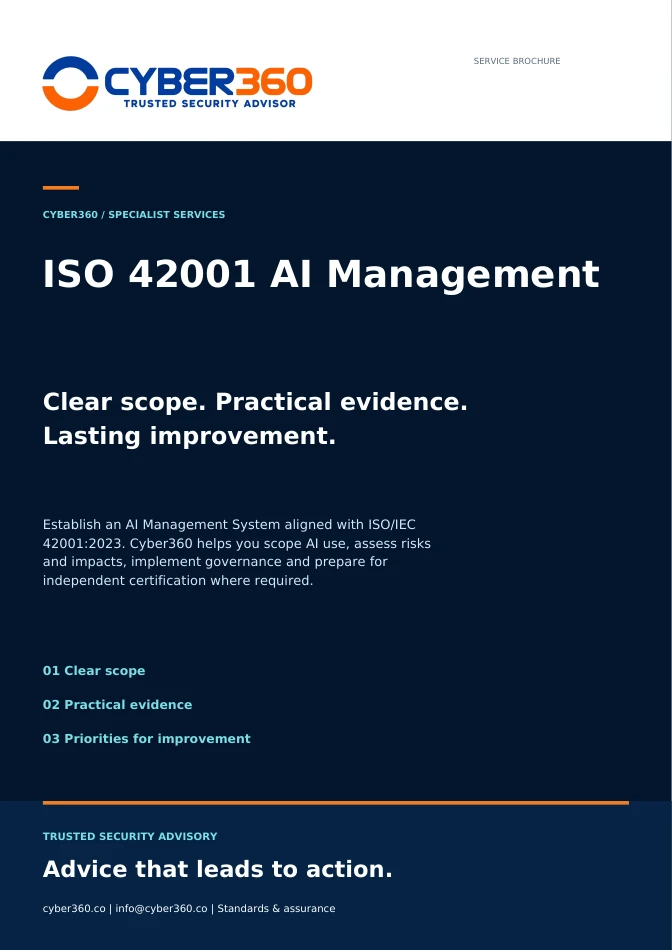
Take a closer look
Download the Cyber360 ISO 42001 AI Management brochure for the service scope, engagement approach, deliverables and preparation guidance.
PDF · 4 pages · 520 KB
Your next step
Tell us the decision you need to make. We’ll help define a useful scope.