Clear Responsibilities
Understand your role, information flows and obligations before investing in a compliance programme.

Hipaa compliance
Build a practical approach to protecting health information. Cyber360 helps covered entities and business associates assess HIPAA gaps, manage security risks and put privacy, security and breach-response procedures into everyday operation.
Healthcare privacy & security • Practical safeguards. Clear accountability.
From questions to decisions
Health information moves across clinical systems, billing platforms, suppliers and workforce workflows. We help you understand that environment, prioritise the risks and build safeguards that support both information protection and effective operations.
Understand your role, information flows and obligations before investing in a compliance programme.
Focus effort on the risks to electronic protected health information and the controls that need attention.
Connect policies, workforce training and operational evidence with a sustainable improvement plan.
When it adds value
Determine whether covered-entity or business-associate requirements apply to your activities and relationships.
Review implications of new clinical systems, telehealth services, hosting arrangements or supplier access.
Organise policies, risk analysis, training records and control evidence for partner or regulatory enquiries.
Clarify how staff identify, escalate, investigate and assess potential breaches of protected health information.
Service areas
These are examples for scoping, not an all-inclusive package. Technologies, delivery expertise, access requirements and outputs are confirmed before an engagement.
What applies, and where are the gaps?
Where is electronic health information at risk?
Do safeguards fit the environment?
Can teams handle health information appropriately?
Are people and partners clear about their duties?
Can you respond and maintain progress?
How it works
Confirm your role, activities, PHI flows and the systems and relationships to review.
Review policies, safeguards, workforce practices and existing compliance documentation.
Identify ePHI threats and vulnerabilities and prioritise risks with accountable owners.
Develop agreed policies, risk treatments, safeguard guidance and operational workflows.
Deliver role-based awareness and walk through privacy and breach-response responsibilities.
Maintain evidence, track remediation and reassess following material operational or technology changes.
What you receive
The reporting package is agreed around your audience and the decisions it needs to support.
Meaningful progress
Agree what completion means for each action: an approved design decision, a reviewed configuration, a resolved finding or a demonstrated process. Record owners, dependencies, exceptions and the evidence available.
Review the programme when systems, facilities, threats or business-associate relationships change. Keep risk decisions and supporting documentation current.
Preparing the engagement
Reference guidance: HHS: HIPAA guidance for professionals. Relevant practices are selected for the agreed scope; applicable requirements and evidence boundaries are agreed during scoping.
Clear boundaries
The engagement supports agreed HIPAA requirements, activities and evidence. Your organisation retains responsibility for compliance decisions and control operation. Specialist legal opinions, regulator representation and production implementation require explicit agreement.
Explore privacy governance, individual rights and personal-data risk management.
Explore the service →Connect health-information safeguards with a wider security management system.
Explore the service →Review architecture, control design and operational readiness.
Explore the service →Practical questions
The HIPAA Rules apply to covered entities and business associates as defined by US law. Covered entities include health plans, healthcare clearinghouses and healthcare providers conducting specified electronic transactions. Handling health information alone does not automatically make an organisation subject to HIPAA.
Protected health information is individually identifiable health information within HIPAA scope. The Privacy Rule covers PHI in different forms; the Security Rule focuses on electronic PHI and its administrative, physical and technical safeguards.
No. This service provides consulting, risk assessment and implementation support. It does not provide HHS approval or a government-recognised HIPAA compliance certificate, and an assessment does not guarantee compliance.
No. A scan can inform the analysis, but a meaningful risk analysis considers the ePHI environment, threats, vulnerabilities, existing controls, likelihood and impact. Scope and evidence limitations must be documented.
We help establish processes to assess incidents and determine applicable notifications, recipients and deadlines under the Breach Notification Rule. Business-associate agreements and other applicable laws may add obligations. Decisions and supporting evidence need to be recorded.
No. HIPAA is a US framework and does not replace other applicable privacy, healthcare or security laws. Additional regimes and specialist legal advice are scoped separately.
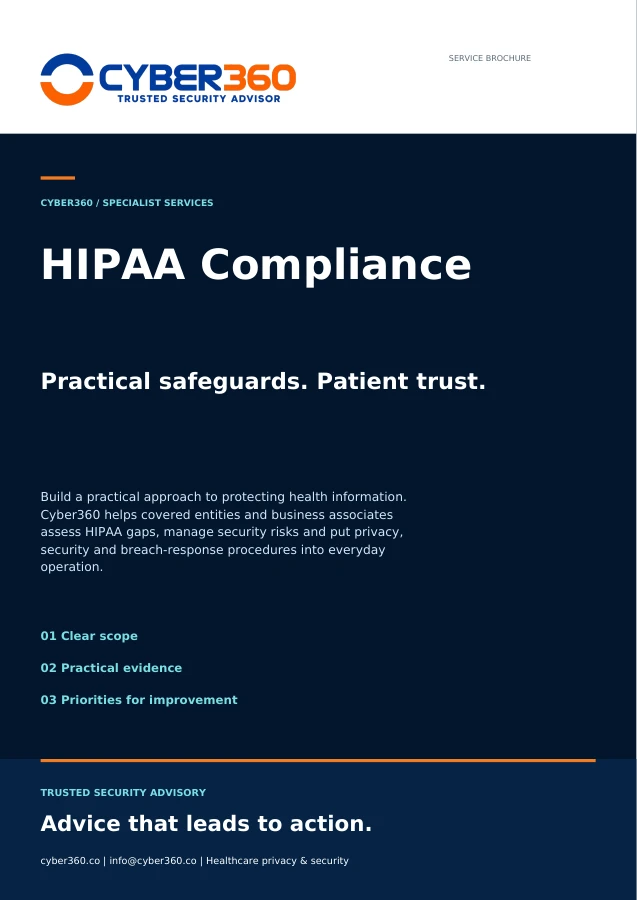
Take a closer look
Download the Cyber360 HIPAA Compliance brochure for the service scope, engagement approach, deliverables and preparation guidance.
PDF · 4 pages · 520 KB
Your next step
Tell us the decision you need to make. We’ll help define a useful scope.