Earlier Decisions
Consider security requirements and trust boundaries while design choices are still being made.

Secure development
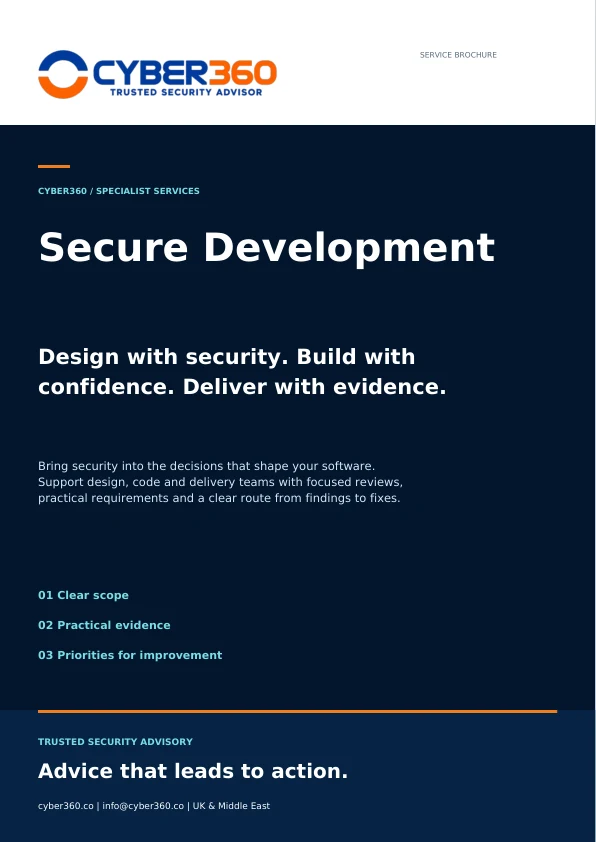
Bring security into the decisions that shape your software. Support design, code and delivery teams with focused reviews, practical requirements and a clear route from findings to fixes.
UK & Middle East • Practical advice. Clear priorities.
From questions to decisions
A late-stage finding can reveal a decision made much earlier in development. Connect requirements, design, implementation and release practices so teams can address the causes of weaknesses as well as individual defects.
Consider security requirements and trust boundaries while design choices are still being made.
Connect review evidence to affected components, relevant conditions and practical remediation.
Build security checks and responsibilities into the way teams already deliver software.
When it adds value
Consider security requirements, sensitive data and abuse cases before implementation is fixed.
Review new APIs, authentication flows, integrations or changes to trust boundaries.
Look beyond individual fixes to understand patterns in design, code or delivery practices.
Clarify what security evidence and approval criteria should inform a release decision.
Service areas
These are examples for scoping, not an all-inclusive package. Technologies, delivery expertise, access requirements and outputs are confirmed before an engagement.
What must the software protect, and from whom?
Where could implementation undermine the intended protection?
Where should security decisions happen in your delivery process?
What does your software inherit and rely on?
How is code protected on its way to production?
How can teams prevent the same issue returning?
How it works
Agree its purpose, sensitive information, users, architecture and the decisions you need to support.
Confirm repositories, versions, technologies, access, environments and coverage priorities.
Review the agreed material using specialist analysis and appropriate supporting tools.
Work through evidence, prerequisites, impact and remediation options with the team.
Translate findings into a practical backlog and agreed development or assurance actions.
Scope follow-up validation and regression guidance where needed, then address recurring causes.
What you receive
The reporting package is agreed around your audience and the decisions it needs to support.
Meaningful progress
Agree what completion means for each action: an approved design decision, a reviewed configuration, a resolved finding or a demonstrated process. Record owners, dependencies, exceptions and the evidence available.
A closed task is not automatically a validated security outcome. Choose the follow-up review or test that answers the original question, and record what remains unverified.
Preparing the engagement
Reference guidance: NIST Secure Software Development Framework. Relevant practices are selected for the agreed scope; this does not imply accreditation or assessment against every requirement.
Clear boundaries
The review applies to agreed components, versions and evidence. It does not guarantee complete coverage, certify a product or transfer responsibility for release decisions. Code changes, production deployment and active testing require explicit agreement.
Assess a running application through separately scoped technical testing.
Explore the service →Connect application decisions with wider architecture, risk and operational controls.
Explore the service →Explore the governance and management-system context for security practices.
Explore the service →Practical questions
No. Reviewing source and design can reveal issues that are difficult to see externally, while testing running software examines its behaviour in a deployed environment. The appropriate combination depends on the objective.
Required expertise, tool support and delivery capability are confirmed during scoping. We do not assume that every technology can be covered by the same review.
The agreed review provides findings and guidance. Remediation implementation or embedded development support requires a defined scope, responsibilities and acceptance criteria.
Tools can help identify and organise potential issues, but their output needs context and review. The balance of manual analysis and automation, and its coverage, is agreed for the engagement.
The aim is to fit meaningful security decisions into your workflow. We review the selected stages and propose changes that reflect your team, product and delivery constraints.
No. Conclusions apply to the reviewed scope and version, with stated limitations. New changes and newly discovered issues require ongoing security work and appropriate follow-up.
Take a closer look
Download the Cyber360 Secure Development brochure for the service scope, engagement approach, deliverables and preparation guidance.
PDF · 4 pages · 520 KB
Your next step
Tell us the decision you need to make. We’ll help define a useful scope.