Business-Led Priorities
Relate security gaps to the services, information and decisions your organisation depends on.

Defensive security
Connect risk, architecture and operational readiness. Understand where your defences need attention and turn the findings into a prioritised plan your teams can act on.
UK & Middle East • Practical advice. Clear priorities.
From questions to decisions
Security investments work best when they address a defined business risk. Bring your assets, control decisions and response capability into one conversation, then focus effort where improvement matters most.
Relate security gaps to the services, information and decisions your organisation depends on.
Review available evidence and distinguish implemented controls from documented intentions.
Translate findings into actions with dependencies, suggested ownership and sensible sequencing.
When it adds value
Review the implications of new infrastructure, remote access, cloud adoption or a business integration.
Build a clearer picture of where key controls apply, where evidence is missing and what needs investigation.
Organise evidence and improvement priorities for internal governance or customer assurance discussions.
Clarify requirements before selecting products, commissioning work or issuing an RFP.
Service areas
These are examples for scoping, not an all-inclusive package. Technologies, delivery expertise, access requirements and outputs are confirmed before an engagement.
What matters most, and what could affect it?
Could your organisation recognise and handle a security event?
Are the security decisions right for the environment?
Are important systems configured as intended?
Can people turn the policy into a consistent decision?
What should change first, and how will you know it helped?
How it works
Agree the business question, target services, stakeholders and boundaries.
Review agreed documents, architecture, configurations and operational information through approved access.
Compare the evidence with agreed requirements and relevant practices, recording assumptions and limitations.
Discuss impact, existing safeguards, feasibility and dependencies with accountable owners.
Set out recommended actions and the evidence needed to demonstrate progress.
Agree any implementation support, follow-up review or technical validation as a separate work package.
What you receive
The reporting package is agreed around your audience and the decisions it needs to support.
Meaningful progress
Agree what completion means for each action: an approved design decision, a reviewed configuration, a resolved finding or a demonstrated process. Record owners, dependencies, exceptions and the evidence available.
A closed task is not automatically a validated security outcome. Choose the follow-up review or test that answers the original question, and record what remains unverified.
Preparing the engagement
Reference guidance: NCSC 10 Steps to Cyber Security. Relevant practices are selected for the agreed scope; this does not imply accreditation or assessment against every requirement.
Clear boundaries
Advisory findings depend on the scope and evidence available. A document review is not proof that a control works in practice. Production changes, active testing, incident response and ongoing operations are not included unless explicitly agreed.
Investigate and validate weaknesses within an authorised technical scope.
Explore the service →Explore operational monitoring, investigation and response support.
Explore the service →Validate selected control and response outcomes through an agreed scenario.
Explore the service →Practical questions
No. This review focuses on risk, control design, configuration evidence and readiness. Active exploitation or attack simulation is only undertaken through a separately scoped and authorised engagement.
A review does not automatically authorise changes. Any implementation support needs an agreed scope, approvals, testing and change-control arrangements.
Yes, the engagement can focus on a defined procurement or design decision. We agree the requirements, evaluation criteria and documents to produce or review.
No. Findings can inform assurance work, but a scoped advisory review does not certify compliance or establish that every applicable requirement has been met.
No. Ongoing monitoring and response are separate service requirements. Where useful, the findings can help define a SOC operating model or monitoring priorities.
It depends on the scope, complexity, evidence availability and stakeholder access. The proposal sets out the work, dependencies, outputs and schedule.
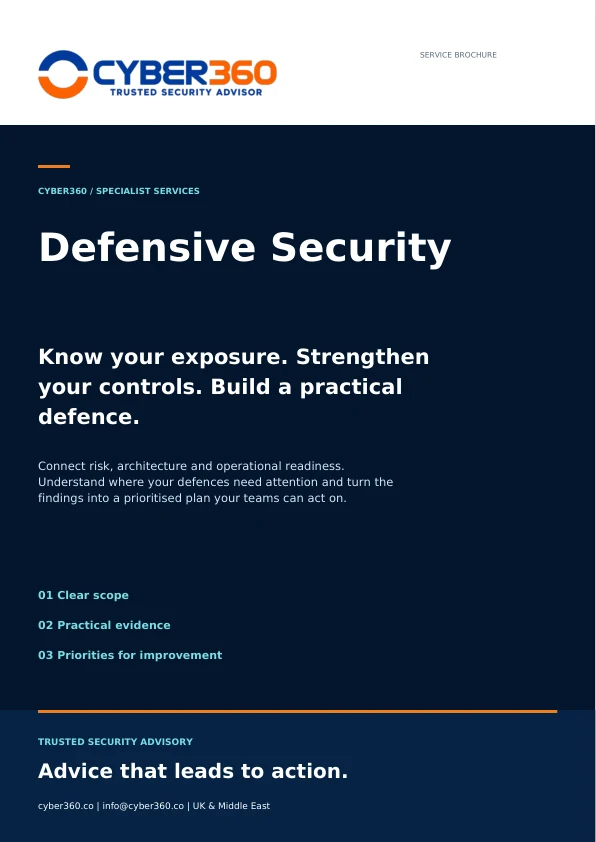
Take a closer look
Download the Cyber360 Defensive Security brochure for the service scope, engagement approach, deliverables and preparation guidance.
PDF · 4 pages · 520 KB
Your next step
Tell us the decision you need to make. We’ll help define a useful scope.