Visibility That Supports Decisions
Understand personal data, processing purposes and dependencies across your organisation.

Data privacy & protection
Connect privacy governance with the way your organisation collects, uses, shares and protects personal data. Cyber360 helps you assess maturity, prioritise risks and build practical privacy controls across the data lifecycle.
Privacy & data protection • Practical controls. Clear accountability.
From questions to decisions
Multiple laws, complex suppliers and changing technologies can leave privacy work fragmented. We help create a shared view of your obligations, data flows and operational priorities, then turn that view into a programme your teams can use.
Understand personal data, processing purposes and dependencies across your organisation.
Embed privacy into products, procurement and everyday workflows with clear responsibilities.
Develop governance, evidence and review processes that can adapt to new initiatives and jurisdictions.
When it adds value
Establish a maturity baseline, ownership and a practical roadmap for improvement.
Identify relevant privacy regimes and separate common controls from local requirements.
Bring privacy risk assessment into analytics, AI, digital services and design decisions.
Connect rights requests, preferences, suppliers, transfers and incident readiness into coherent operations.
Service areas
These are examples for scoping, not an all-inclusive package. Technologies, delivery expertise, access requirements and outputs are confirmed before an engagement.
What should the programme focus on?
Where does personal data travel and how is it protected?
Are risks considered before delivery?
Can individuals understand and control relevant uses?
Are external dependencies understood?
Can the programme operate consistently?
How it works
Define business priorities, jurisdictions, processing scope and stakeholders.
Discover personal data flows and review maturity, safeguards and operational evidence.
Set actions around risks to individuals, obligations, business impact and dependencies.
Develop agreed governance, documentation, workflows and design guidance.
Assign ownership, deliver awareness and walk through key operating processes.
Measure progress, maintain evidence and reassess following material change.
What you receive
The reporting package is agreed around your audience and the decisions it needs to support.
Meaningful progress
Agree what completion means for each action: an approved design decision, a reviewed configuration, a resolved finding or a demonstrated process. Record owners, dependencies, exceptions and the evidence available.
Keep records, notices and risk decisions current. Review the programme when purposes, technologies, suppliers or jurisdictions change.
Preparing the engagement
Reference guidance: NIST Privacy Framework. Relevant practices are selected for the agreed scope; applicability and evidence boundaries are agreed during scoping.
Clear boundaries
The engagement supports agreed activities, jurisdictions and evidence. Your organisation retains responsibility for processing decisions, legal obligations and control operation. Specialist legal opinions, formal audits, regulator representation and production implementation require explicit agreement.
Explore focused support for EU GDPR obligations.
Explore the service →Address California consumer privacy requirements.
Explore the service →Connect privacy priorities with security architecture and controls.
Explore the service →Practical questions
No. The programme begins with your processing activities and relevant jurisdictions. Specific legal regimes and deliverables are agreed at scoping; common controls do not remove local obligations.
Cybersecurity protects information and systems. Privacy also considers why personal data is used, how it affects individuals and whether practices are appropriate. The two disciplines work together.
Yes. Agreed work can include data flows, assessment triggers, minimisation, safeguards and approval gates. Specialist legal opinions or technology implementation need a defined work package.
Tool requirements and integration guidance can be included. Procurement, configuration, automation and production deployment are only included when explicitly agreed.
Yes, where useful. We review its fit for current processing and other applicable regimes, then identify gaps rather than assuming one set of documents covers everything.
No. This is advisory and implementation support for an agreed scope. It does not guarantee compliance or provide regulatory approval; ongoing decisions and control operation remain your responsibility.
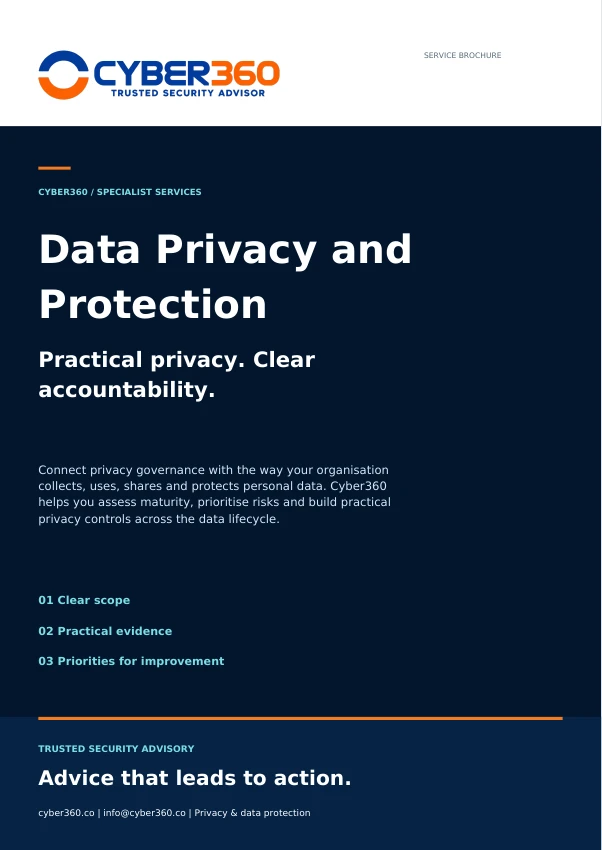
Take a closer look
Download the Cyber360 Data Privacy & Protection brochure for the service scope, engagement approach, deliverables and preparation guidance.
PDF · 4 pages · 520 KB
Your next step
Tell us the decision you need to make. We’ll help define a useful scope.