Objective-Based
Focus on realistic attacker goals and the business assets that matter most.

Red teaming & cyber attack simulation
From focused attack scenarios to an end-to-end red team exercise, understand how an adversary could reach your critical assets and how effectively your defenders respond.
UK & Middle East • Controlled, authorised engagements
Service overview
Choose focused cyber attack simulation to validate a specific scenario, or red teaming to examine a broader adversary journey. These are separate services, each scoped around your maturity, critical assets and the questions you need answered.
Focus on realistic attacker goals and the business assets that matter most.
Shape scenarios around adversaries, campaigns and techniques relevant to your industry.
Evaluate how effectively your teams identify, investigate and contain attacker activity.
Choose your exercise scope
Agree the objective, depth, defender involvement and operational boundaries before testing begins.
Exercise scope is agreed individually. This is a human-led assessment service; automated Breach & Attack Simulation (BAS) platforms are a separate offering. Any availability or DDoS testing requires a separately agreed scope and safeguards.
Assessment focus
Test the whole security programme and the paths that could lead an attacker to your critical assets.
Employee exposure, social engineering scenarios and the response of your security team.
Escalation, investigation, incident handling and containment decisions during an exercise.
External defences, monitoring tools, access controls and internal security boundaries.
How controlled initial access could lead to lateral movement and elevated privileges.
Whether an adversary could reach agreed high-value systems, information or crown jewels.
What is detected, what is missed and how your defenders respond to the simulated threat.
Controlled and authorised
Every exercise starts with defined objectives and rules of engagement. Scope, constraints and success criteria are agreed before activity begins.
Systems, people, assets and scenarios included in the exercise.
Prohibited activities and measures to manage operational risk.
Exercise contacts, escalation routes and communication protocols.
Emergency procedures and the conditions for pausing activity.
Our approach
An illustrative end-to-end approach. The stages used and their depth depend on the exercise scope agreed with you.
Research relevant threat actors, campaigns and attack techniques to build the adversary profile for your exercise.
Define realistic objectives, constraints and success criteria around your organisation and its most valuable assets.
Agree scope boundaries, prohibited activities, safety measures, communication protocols and emergency procedures.
Identify exposed assets, potential entry points and publicly available organisational, employee and technical information.
Test agreed entry routes, such as external vulnerabilities, phishing scenarios or simulated supply chain compromise.
Evaluate firewalls, VPNs, email gateways and web filtering against techniques relevant to your threat scenario.
After controlled access, identify high-value targets and test internal movement while evaluating detection.
Test whether credentials, misconfigurations or trust relationships could allow an attacker to gain higher-level access.
Within agreed boundaries, evaluate techniques that could maintain access across system reboots or credential changes.
Attempt to reach agreed high-value systems or data to demonstrate the potential impact of the simulated attack.
Document detection events, security-team responses and containment actions to assess monitoring, incident response and threat hunting.
The outcome
A clearer view of your actual resilience, the gaps exposed by the exercise and priorities for improvement.
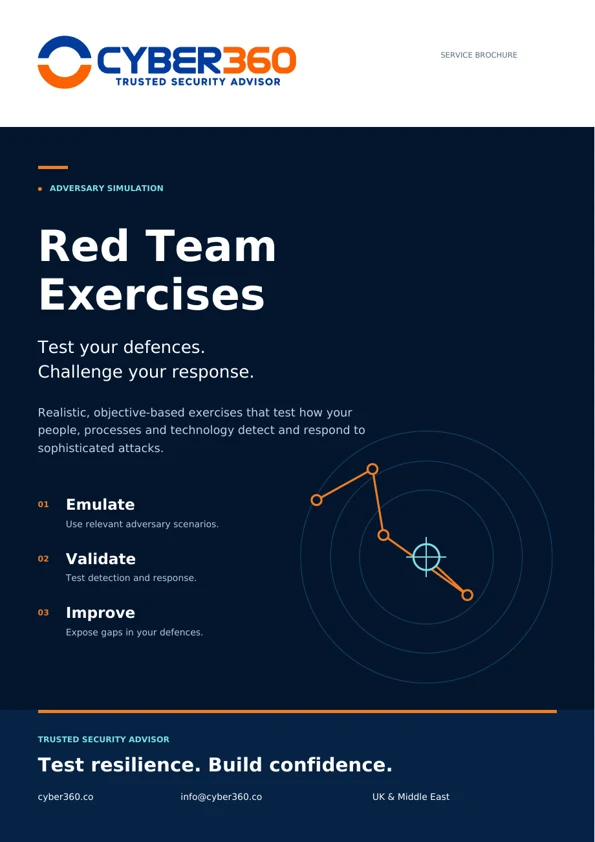
Take a closer look
Download the Cyber360 brochure for the service overview, assessment focus areas and all eleven stages of the exercise process.
PDF · 3 pages · 539 KB
Your next step
Tell us what you want to validate. We’ll help define a focused scenario or a broader red team exercise.